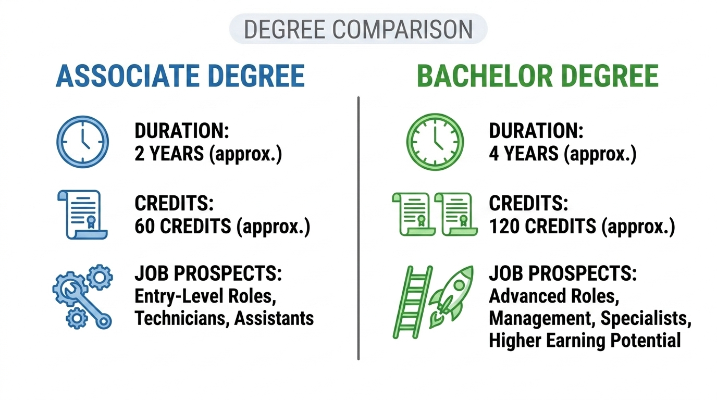
An associate degree is a two-year higher education credential designed to provide foundational knowledge and skills in a specific field, while a bachelor’s degree typically requires four years of study and offers a more comprehensive academic curriculum. The duration and credit requirements for both degrees vary by institution and the student’s enrollment pattern, influencing the time and investment needed to complete each educational path. Understanding these differences is essential, as they significantly shape a student’s educational journey and future career prospects. Thus, examining the merits of each option can help individuals align their academic choices with their goals.
What Is a Degree? Types of Academic Degrees Explained
Associate Degrees: AA, AS, and AAS
Associate degrees require two years of study and provide foundational education, categorized into three main types: Associate of Arts (AA), Associate of Science (AS), and Associate of Applied Science (AAS). The AA degree focuses on liberal arts education and is ideal for students intending to transfer to a four-year institution, with fields of study including humanities, social sciences, and fine arts. Conversely, the AS degree emphasizes scientific and mathematical principles, preparing students for further studies in health sciences, engineering, or technology. AAS degrees, on the other hand, prioritize career readiness, equipping students with practical skills for specific occupations such as nursing or culinary arts.
Bachelor’s Degrees: BA and BS
Bachelor’s degrees, particularly the Bachelor of Arts (BA) and Bachelor of Science (BS), generally require four years of study. BA degrees typically include a liberal arts education, which emphasizes critical thinking and analytical writing across various fields such as literature and social sciences. In contrast, BS degrees focus on scientific and technical disciplines, incorporating a greater number of math and technology-based coursework; common areas of study include engineering and health sciences. Students in both degree types explore advanced concepts and engage in in-depth research, thereby positioning themselves favorably for a broad range of career opportunities. In summary, while associate degrees may be used to transition to further education or facilitate immediate job entry, bachelor’s degrees provide a more substantial foundation for advanced career prospects or specialized academic studies.
How Degree Programs Work: Duration, Credits, Curriculum, and Institutions
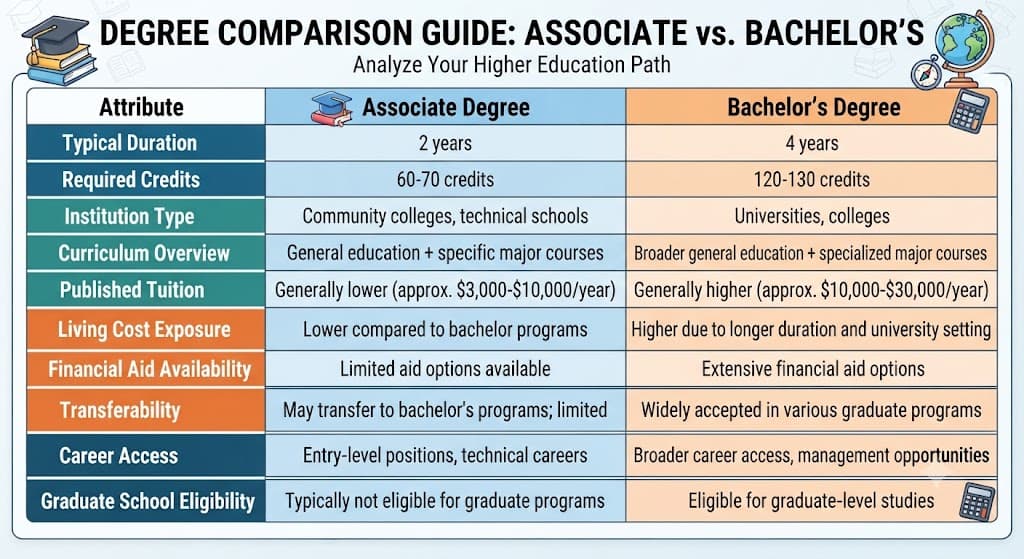
When considering higher education, understanding the degree commitments is crucial. An associate degree typically requires approximately 60 credit hours and can be completed in two years at a community college. The coursework generally includes general education, foundational subjects, and specialized training, making it an ideal choice for those aiming for quick entry into the workforce. In contrast, a bachelor's degree demands around 120 credit hours, unfolding over four years at universities. This route includes an in-depth study within a major, complemented by general education courses and electives, adequately preparing graduates for broader career opportunities.
Institutions offering these degrees differ significantly. Community colleges primarily award associate degrees, focusing on career readiness at lower tuition costs, while universities confer bachelor’s degrees, offering a comprehensive academic experience. As such, students must thoughtfully evaluate their educational ambitions and career goals when choosing between these pathways, considering the time and financial investment associated with each degree type.
Understanding Degree Costs: Sticker Price, Net Cost, Financial Aid, and Opportunity Cost
Embarking on the journey of higher education necessitates an understanding of financial implications, particularly when comparing associate and bachelor’s degrees. The term “sticker price” refers to published tuition rates before any discounts, whereas “net price” is the actual amount students pay after applying grants and scholarships. According to the College Board, in the 2022-2023 academic year, the average sticker price for public four-year institutions was about $10,940 for in-state students; many students attending these institutions significantly reduced their net price due to financial aid packages, averaging around $14,000 annually.
Additionally, prospective students should account for living expenses, which can range from $10,000 to $20,000 annually, influenced by location and lifestyle choices. Financial aid options, including federal grants, scholarships, and loans, are available to make higher education more accessible. Furthermore, students must consider the concept of opportunity cost, which embodies the income forgone while attending school instead of working. With associate degrees, students often begin earning sooner, potentially offsetting some costs more quickly than with a bachelor’s degree, which necessitates four years of study. By considering these aspects, students can evaluate the financial commitment needed for each type of degree, aligning education with long-term financial stability and career aspirations.
Career Opportunities and Earning Potential After Earning a Degree
Education significantly influences career access and potential earnings, as evidenced by data from the Bureau of Labor Statistics (BLS). Recent findings reveal that individuals holding a bachelor’s degree typically experience lower unemployment rates compared to those with only an associate degree, with unemployment for bachelor’s degree holders at approximately 2.5%, in contrast to 3.8% for those possessing an associate degree.
Regarding earnings, the disparity becomes clear. On average, bachelor’s degree recipients earn around $1,305 weekly, whereas individuals with associate degrees earn approximately $836 weekly, establishing an annual earning gap exceeding $24,000. This difference underscores the financial impact that educational level can have on career trajectories. However, it is crucial to acknowledge that numerous factors—including industry demands and individual circumstances—affect these outcomes. Therefore, while earning a higher degree correlates with improved income potential and job security, it is important not to imply direct causation, as each degree type may open different avenues in various professional sectors.
In summary, pursuing higher education can enhance access to a wider range of career opportunities. However, prospective students must consider their unique career aspirations and the corresponding educational requirements before making critical decisions.
Degree Pathways: Transfer Options and Further Education Opportunities
Understanding the transferability between associate and bachelor’s degree programs is vital for students looking to advance their educational credentials. Having transfer agreements between community colleges and universities often enables students to transition their credits seamlessly, decreasing both time and financial burden. For example, programs such as the California State University Transfer Admission Guarantee (TAG) allow guaranteed admission to students meeting specific criteria, simplifying access to bachelor’s programs.
Further pathways for continuing education after obtaining an associate or bachelor’s degree also vary widely. Students may opt for specialized certifications, additional degrees, or professional development courses to enhance their job prospects. Institutions such as the University of Phoenix and Southern New Hampshire University provide flexible online degree programs tailored to adult learners, promoting lifelong education and career growth. These educational paths not only improve career options but also underscore the foundational importance of transfer agreements in higher education.
Which Degree Option Is Right for You?
When contemplating whether to pursue an associate or bachelor’s degree, students often come from diverse backgrounds and have different career aspirations. For instance, working adults balancing full-time jobs may choose associate degrees, which allow for quicker workforce entry with applicable skills, particularly in sectors like healthcare or technical support. In contrast, recent high school graduates aiming for careers in business or engineering are likely to favor bachelor’s degrees, aligning with their ambitions for greater earning potential and expanded career opportunities.
Additionally, first-generation college students may appreciate associate degrees due to their lower costs and shorter timelines, granting them confidence and academic experience before pursuing a four-year program. Students from lower socioeconomic backgrounds may gravitate towards more affordable associate degrees to alleviate immediate financial pressures, while those from higher-income families might prefer bachelor’s degrees to unlock longer-term career growth potential. Ultimately, personal circumstances and career goals significantly influence which educational route proves more advantageous.
How to Choose the Right Degree: Decision Checklist
When weighing the decision between an associate and a bachelor’s degree, prospective students should consider several vital factors. Distinct differences exist in program length, cost, and potential earnings. An associate degree generally offers a quicker path to workforce readiness, whereas a bachelor’s degree may lead to higher earning potentials and more extensive career opportunities. To navigate this decision-making process effectively, utilize the following checklist:
- Target Occupation: What are the educational prerequisites for your desired career?
- Program Reputation: Are the programs accredited and positively reviewed?
- Total Net Cost: What is the overall fiscal commitment for each educational route?
- Completion Likelihood: What are the current students' success rates?
- Time to Income: How soon can you begin earning income in your chosen field?
- Transfer Strategy: If continued education toward a bachelor’s is considered, do you have a concrete plan for credit transfer?
Utilizing this checklist will assist in making a well-informed decision as you embark on your educational journey.